In this area
The Frankfurt issue
Altstadt, Frankfurt: a rebuilt old town under glass towers
Frankfurt’s Altstadt is a compact, reconstructed old town of squares, cathedral stone and market lunches, where the city’s medieval memory sits in the shadow of the skyline.

By Elena VogtFrankfurt one Viertel at a time
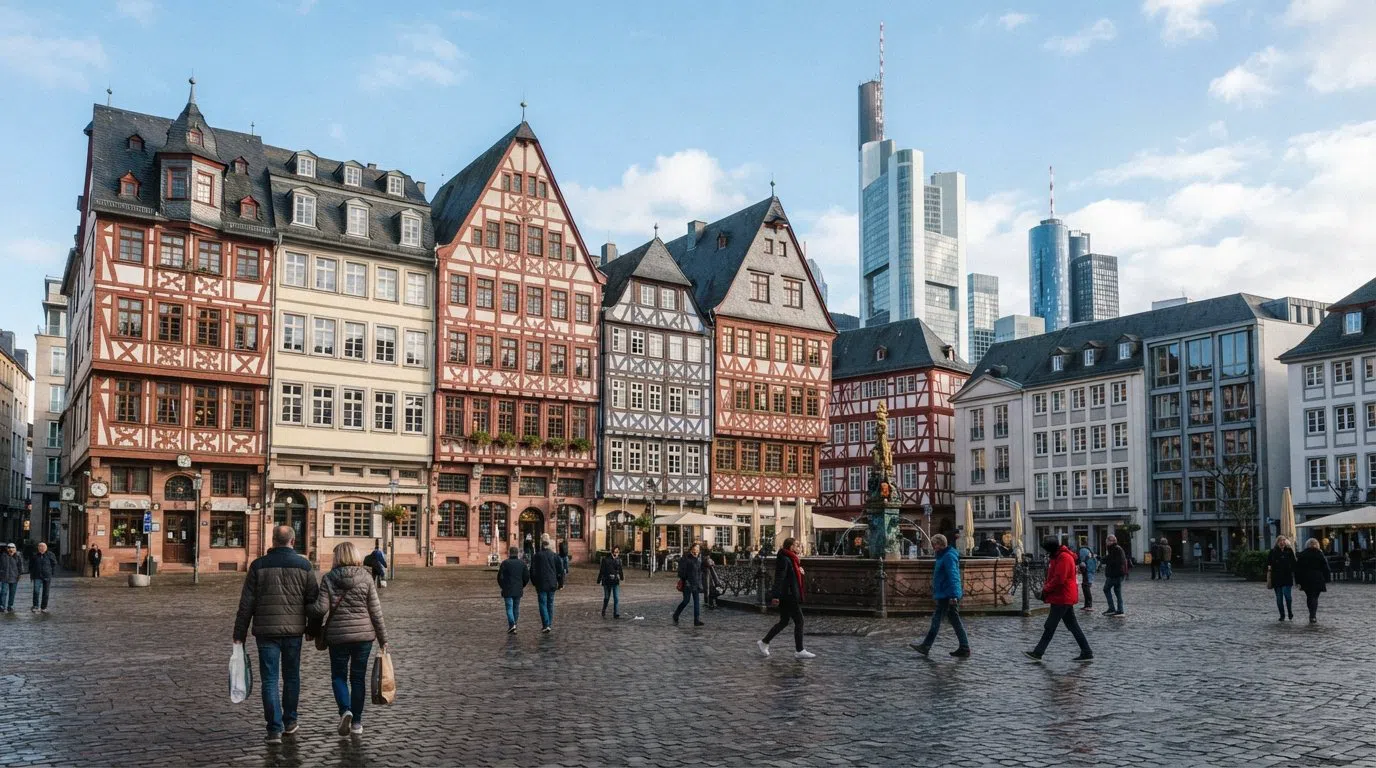
Almost everything you see in Frankfurt’s Altstadt is younger than the person showing it to you, and that is the first thing to understand before you step onto the cobbles. The old town was flattened on 22 March 1944; what returned was not a preserved relic but a deliberate rebuild, brick by brick and beam by beam, with the newest lane between the cathedral and the Römer finished only in 2018. It is a quarter that makes no apology for its own reconstruction. Instead, it wears it openly, under a wall of skyscrapers, so that a glass tower can reflect in the window of a half-timbered house while an apple wine sits on the table beneath a stepped gable.
What the Altstadt is known for
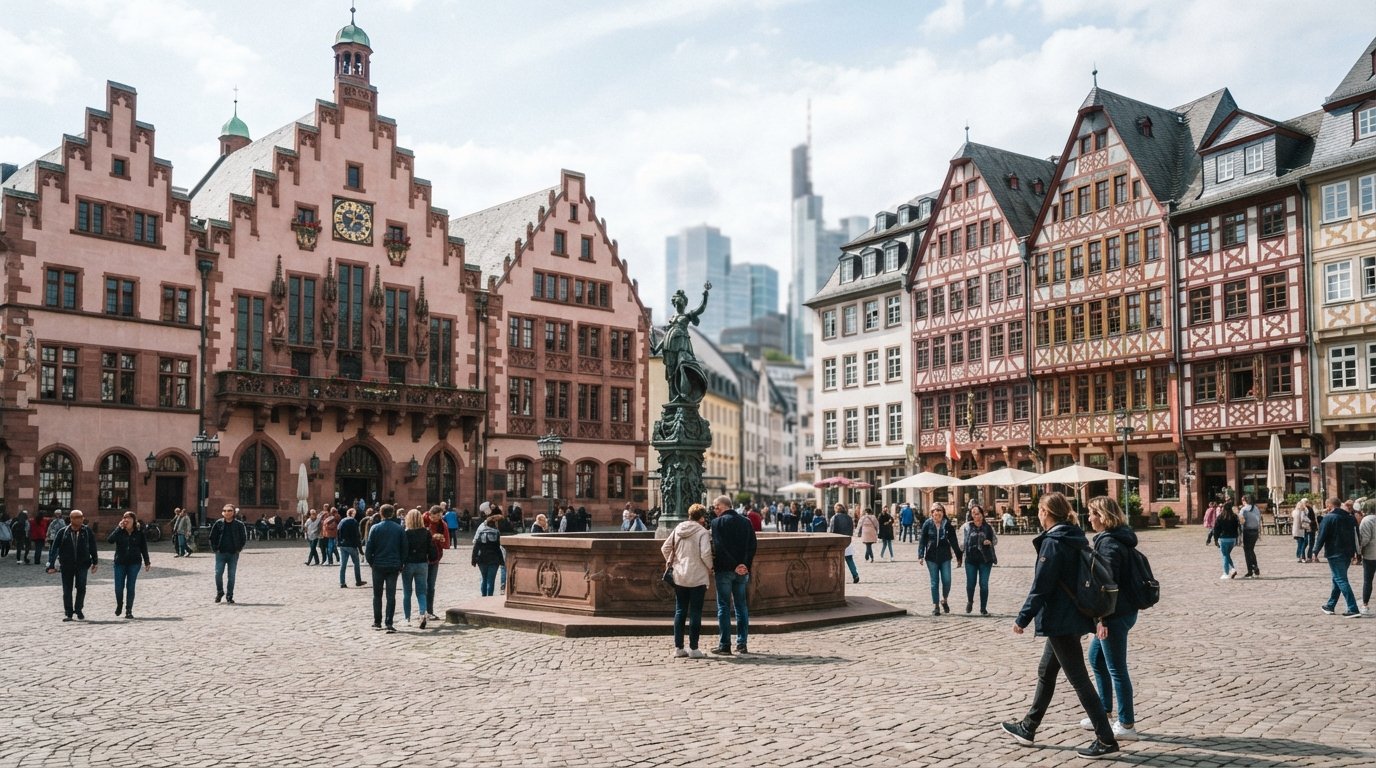
The Altstadt’s headline act is the Römerberg, a square that has been Frankfurt’s civic heart since the Middle Ages and was once called the most beautiful square in the Holy Roman Empire. It is irregular in the way only old civic spaces can be, though here the oldness is partly memory, partly careful rebuilding. On the west side stands the Römer, the town hall since the 15th century, with its three stepped gables and the Kaisersaal upstairs, where portraits of all 52 Holy Roman Emperors look down from the walls when there is no ceremony on. Opposite, the Gerechtigkeitsbrunnen keeps watch, Justitia holding her scales without a blindfold, as if the square itself wanted to make a point about Frankfurt’s sense of itself. And then there is the Ostzeile, the row everybody photographs: steep gables, half-timbering, postcard symmetry. It was rebuilt from historical plans in 1986, which is very Frankfurt — practical, self-aware, and not especially interested in pretending otherwise.
Just behind the cathedral, the mood changes. The Neue Altstadt — the New Old Town — is a five-minute quarter of 35 buildings completed in 2018, a mix of 15 faithful reconstructions and 20 new buildings that reopen the old coronation route between the Dom and the Römer. This is where the city’s reconstruction becomes most legible on foot: arcaded courtyards, narrow passages, and the Hühnermarkt square with the bust of the Frankfurt dialect poet Friedrich Stoltze. The effect is not theme-park nostalgia so much as a city choosing to narrate itself carefully. You can read the plaques and know what is copied, what is new, and what has been rebuilt from photographs and plans; that honesty gives the place a strange, sturdy dignity.
Presiding over all of it is the Kaiserdom, the red-sandstone imperial cathedral whose Gothic tower is the Altstadt’s landmark and whose bells seem to keep time for the whole quarter. It is the tallest note in a small neighbourhood, and from almost anywhere in the old town you can orient yourself by it. The trick is that the Altstadt is tiny — you can walk its edges in fifteen minutes — but it compresses a whole civic history into those few blocks. It is the postcard Frankfurt most visitors come for, yes, but it is also a working seam between the Main and the finance district, where the medieval rooflines are permanently framed by glass towers.
Plan your Frankfurt trip
Live prices from our booking partners.
Guests & rooms
Free cancellation on many rooms. We may earn a commission when you book.
Where to eat & drink
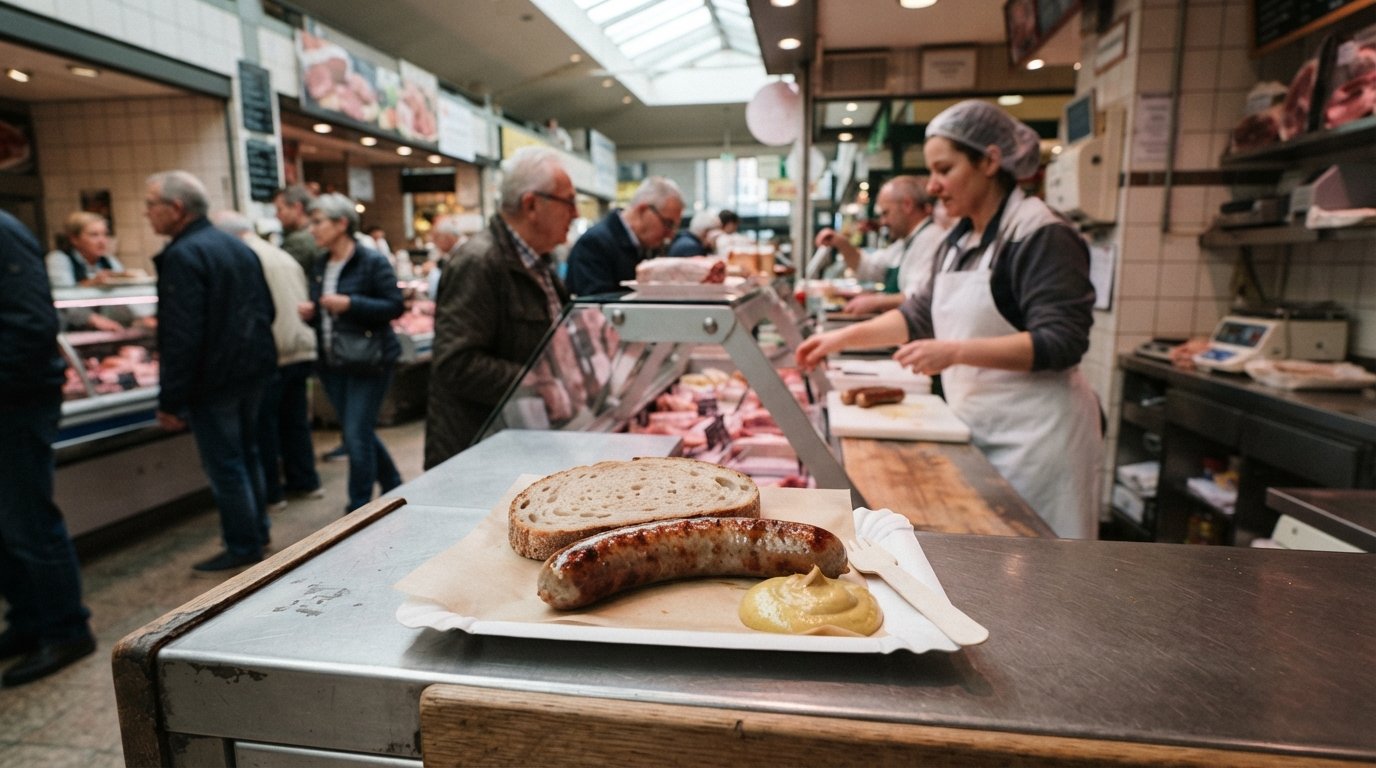
The Altstadt’s stomach is the Kleinmarkthalle, the covered market at Hasengasse 5–7 where around 60 stalls sell cheese, fish, spices and street food, and where lunch is still a local ritual rather than a performance. It is a daytime place — roughly 8am to 6pm on weekdays, until 4pm on Saturday, shut on Sunday — and the rhythm matters. Come when the hall is humming and the queues are part of the pleasure. At Metzgerei Schreiber, just inside the entrance on the ground floor, people line up for hot Frankfurter or a length of sausage on a paper plate with bread and superb mustard. It is simple food, done with the sort of confidence that needs no decoration.
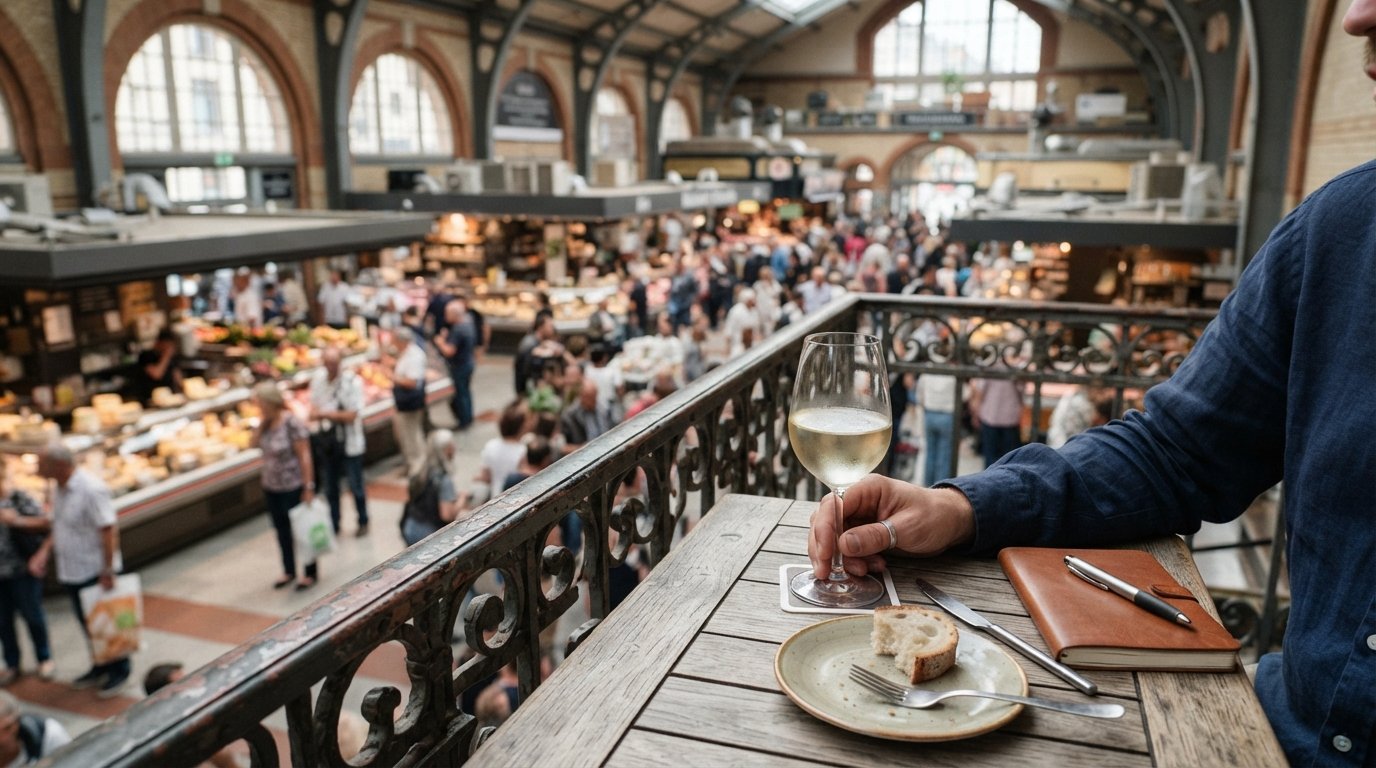
A few aisles over, Gref-Völsing brings its own kind of gravity. This fifth-generation Frankfurt butcher, founded in 1894, serves the city’s own Rindswurst with green sauce and a daily-changing lunch. The line may move, but no one seems in a hurry. Then, if you want to sit above it all for a moment, climb the internal stairs to the Wein-Balkon, the first-floor wine terrace where Rollanderhof pours its wines by the glass and locals nurse a Friday lunchtime Riesling over the market’s hum. It is one of those useful Frankfurt pleasures: not grand, not hidden, simply exactly where it should be.
For a proper sit-down, Margarete on Braubachstraße 18–22 is the kitchen that feels most of the moment. It does modern, ingredient-led German cooking with an open kitchen and a good-value weekday lunch menu, and it sits only a couple of minutes from the Römer, which means you can drift there after the square’s crowds have done their photographing. If you want the more traditional Hessian table, Weinstube im Römer at Römerberg 19 keeps the old forms alive with Handkäse mit Musik, schnitzel and the famous seven-herb Grüne Soße, right on the square itself. And for coffee with actual lineage, Wacker’s Kaffee at Kornmarkt 9 has roasted and served on the same corner since 1914, in an 80-square-metre café that has barely changed since 1955. There is comfort in that sort of continuity, especially in a quarter where so much of the scenery is reconstruction.
Going out
Be honest with yourself about the Altstadt after dark: it is not a nightlife quarter and never really was. Once the day-trippers leave and the market shutters come down, the square and its lanes go quiet, and the drinking crowd moves out. That does not mean the evening is empty; it just means the Altstadt is better at a measured last glass than a long, loud night.
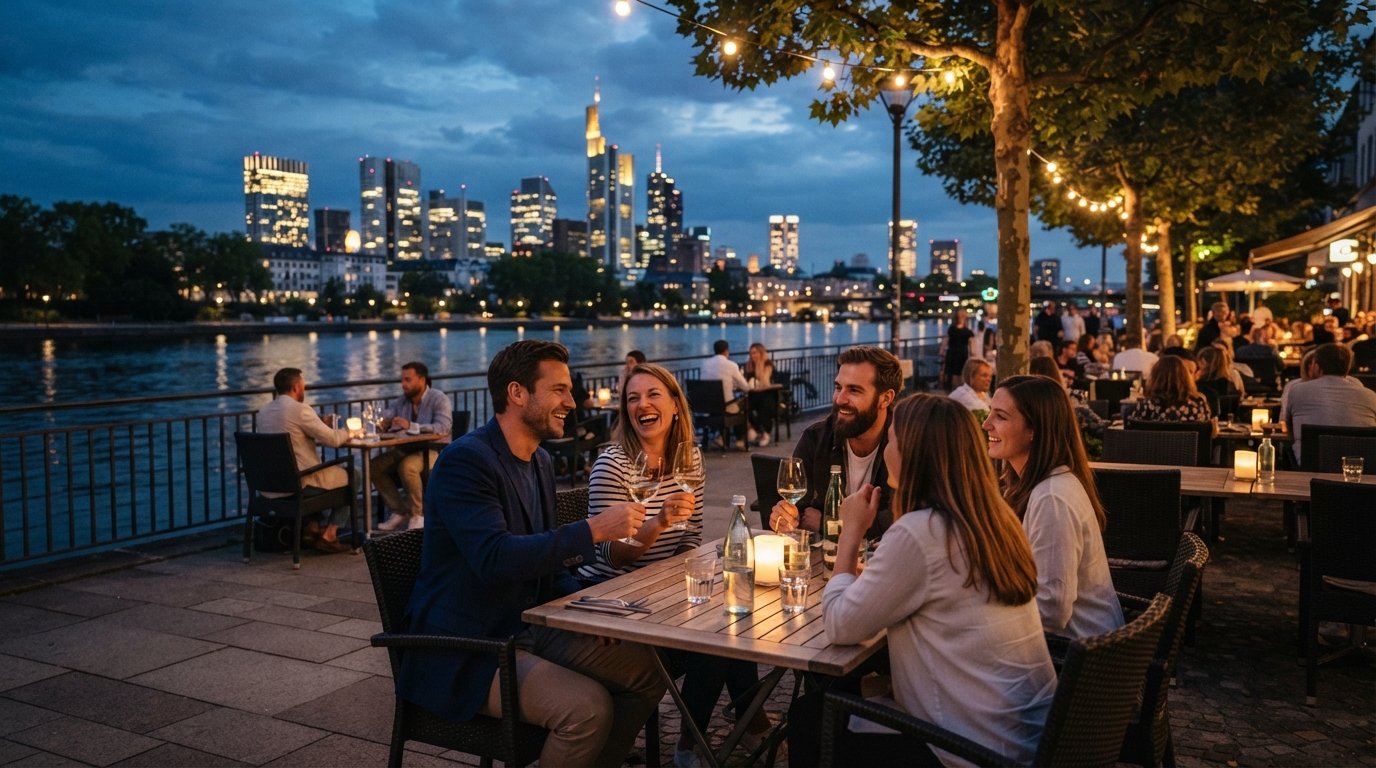
The best version of that is a walk to the river. Follow the Mainkai promenade to the water and take in the skyline lighting up across the Main. A little west along the Untermainkai, MainNizza has one of the best river terraces in the city for a glass of wine at dusk. It is the kind of place that rewards a slow arrival: the river darkening, the towers catching the last light, the old town behind you already settling down. Around the Römer itself, the cafés and half-timbered restaurants of the Ostzeile keep their terraces open into the evening for a relaxed nightcap rather than a big night, which suits the square’s temperament.
When you do want a proper night out, the Altstadt’s greatest asset is how close it is to one. The Eiserner Steg footbridge is barely a minute from the Römerberg, and a ten-minute stroll across it drops you into Alt-Sachsenhausen, the cobbled tangle of apple-wine taverns where a grey-blue Bembel jug of tart Apfelwein and a boisterous bench are the whole point. In the other direction, the bars and clubs of the Bahnhofsviertel are a short walk or one U-Bahn stop away. So the Altstadt gives you the day’s history and the night’s easy exit; it is a base, not a destination for late hours.
Things to do / what to see
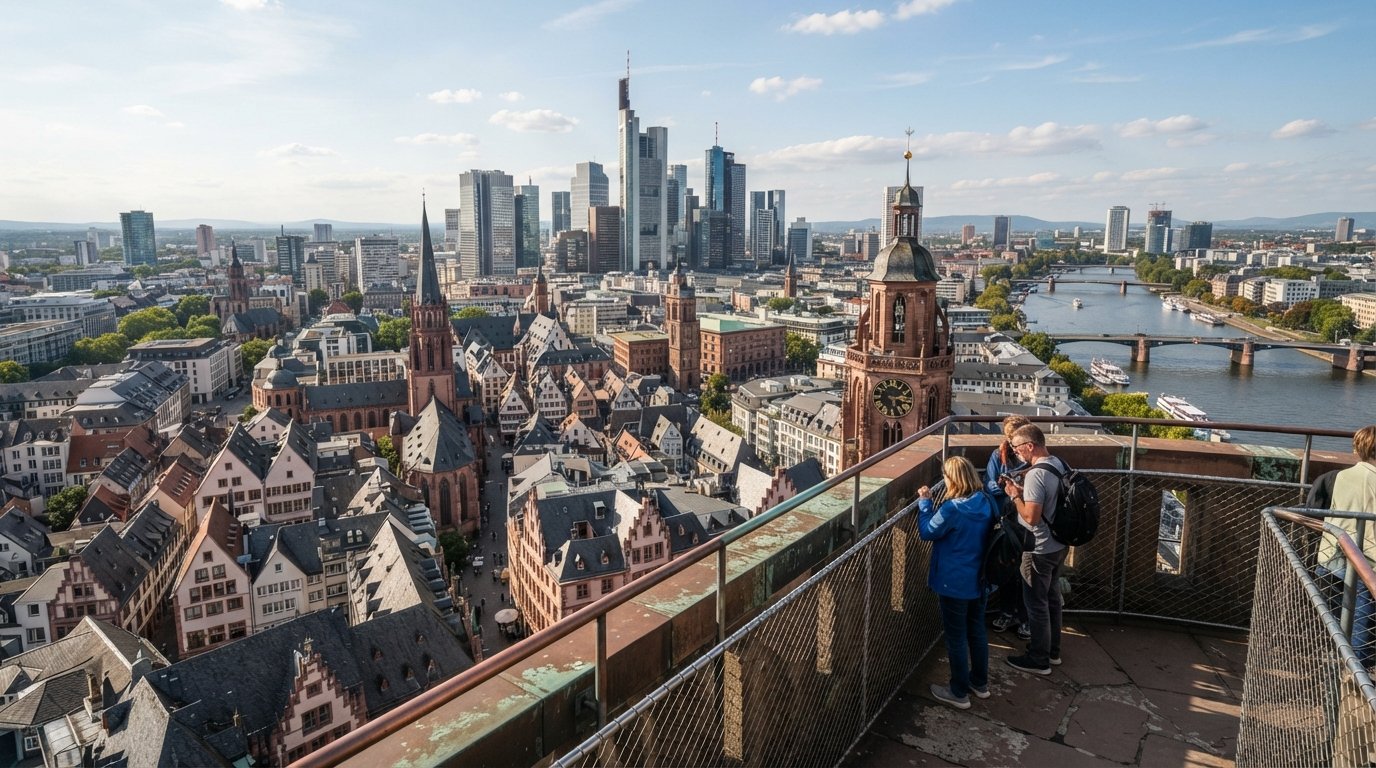
Start at the Kaiserdom and climb it. The 328 steps up the red-sandstone Gothic tower lead to a viewing platform around 66 metres up, and for roughly €3 it is one of the best-value views in the city. Go before the tower closes in the late afternoon — around 5–6pm, earlier in winter — and you get the Altstadt rooftops at your feet, the Museumsufer across the river and the skyline stacked behind it all. The view is useful as well as beautiful: you understand at once how compact the old town is, how close the river lies, how the city’s different centuries sit in the same frame.
From the cathedral, walk the Krönungsweg through the Neue Altstadt. This is the old coronation route, reopened in brick and beam, and it is best taken slowly enough to notice the changes in scale as you move from one lane to another. There are arcaded courtyards at Hinter dem Lämmchen and the Hof zum Rebstock, the Hühnermarkt with Stoltze’s bust, and then Haus zur Goldenen Waage beside the Dom — the ensemble’s most expensive reconstruction, now holding a café and museum rooms. It is lavish without being loud, a house that seems to understand the burden of being photographed all day and still carry itself well.
A short step west stands the Paulskirche, the round sandstone hall where Germany’s first freely elected national assembly met in 1848 to draft a constitution. It is one of those places that can be easy to underplay because the building is so plain from the outside, but the history is not. The rotunda is open daily from 10am to 5pm, with a free exhibition inside, and it remains one of the most important democratic landmarks in the country.
For museums, the Historisches Museum at the Saalhof tells the city’s story across eight exhibitions inside 800-year-old walls and a 2017 new building by the river. It is the place to go if you want the long view, the civic sprawl, the layers that make the Altstadt more than a pretty square. And tucked into the Neue Altstadt, the Struwwelpeter Museum is a small, charming reminder that Frankfurt’s cultural memory is not only imperial and municipal but literary too, tied to Heinrich Hoffmann’s 1844 children’s book. One note for planning: the Schirn Kunsthalle on the Römerberg is closed for renovation until 2027 and has decamped to Bockenheim, so do not build the day around it.
Don’t miss in Altstadt
Römerberg square
Frankfurt Cathedral (Dom)
Schirn Kunsthalle
Shopping & markets
Shopping in the Altstadt is not about hauling bags from a big retail street; it is about edible souvenirs and the small, specific things you notice only when you are walking rather than browsing in a hurry. The Kleinmarkthalle is the obvious place to begin. Take home Frankfurt sausage, Handkäse, spices, coffee and wine from the stalls, and let the market do the work for you. It is the sort of place where the shopping is inseparable from the lunch, which is how markets should be.
On Braubachstraße, the antiques-and-galleries street behind the Römer, Bitter & Zart at number 14 has been an independent chocolatier since 2003, with shelves stacked with bars, pralines and macarons and a plush 1920s-style café next door. If you are the sort of person who can wait for a hot chocolate, it is worth the pause. Wacker’s Kaffee on the Kornmarkt sells its own long-roasted beans by the bag as well as pouring them, which makes it a useful stop if you want to leave the quarter with something that still smells like it. The Neue Altstadt has scattered small shops and cafés among its reconstructed houses, more browse than haul, and that feels right for a place whose pleasures are architectural as much as commercial.
For serious retail, the Zeil is only a couple of minutes’ walk north to the Hauptwache, one of Germany’s busiest shopping streets. That proximity is part of the Altstadt’s utility: you can spend the morning on the Römerberg, lunch in the market, then drift north into department stores and chains without ever needing a car or much planning at all.
Where to stay in the Altstadt
Staying in or beside the Altstadt puts every landmark, the Kleinmarkthalle and the river within a few minutes’ walk, with the Hauptbahnhof a short U-Bahn ride or a twenty-minute stroll away. For a first trip, that is hard to beat. You wake up with the Römerberg close by, the cathedral bells somewhere in the morning air, and the whole old town available before the tour groups are properly awake. The compromise is that central hotels tend to be pricier, and the quarter itself is busy by day and quiet at night — a useful arrangement for some travellers, less so for others.
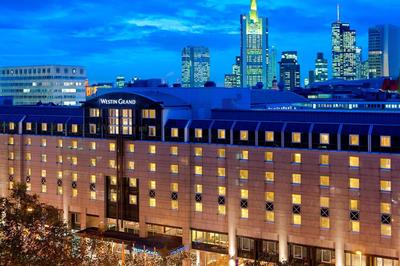
The grand option on the old town’s edge is the Steigenberger Icon Frankfurter Hof, a five-star institution that has taken guests since 1876, with the Römer, Paulskirche and Main Tower a few steps off. The Westin Grand Frankfurt is another polished five-star nearby, and there is a run of reliable mid-range and upscale chains around the fringes of the quarter and up towards the Zeil. For something smaller and gentler on the wallet, look for hotels like the Schopenhauer Hof a short walk towards the river. If you are the sort who wants bars on the doorstep, sleep over the river in Sachsenhausen or near the Bahnhofsviertel and cross back into the Altstadt to sightsee; if you want a central base and do not mind the daytime bustle, the old town makes excellent sense.
Hotels in Altstadt
Our best-rated stays in this neighbourhood. Prices are approximate “from” rates — confirmed at the provider when you continue. We may earn a commission if you book through our partners — at no extra cost to you.
In this area
In this area
In this area
In this area
In this area
In this area
In this area
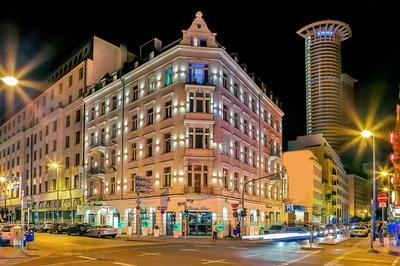
Altstadt
Grand Hotel Downtown - Frankfurt Central Station - Boutique Design Hotel
6.5· 6,963 reviews
approx. from£45 / nightSee prices
In this area
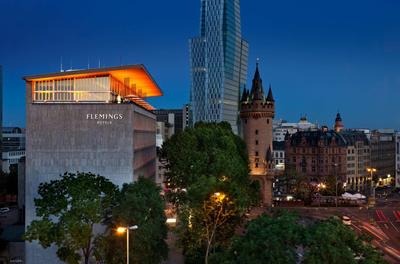
In this area
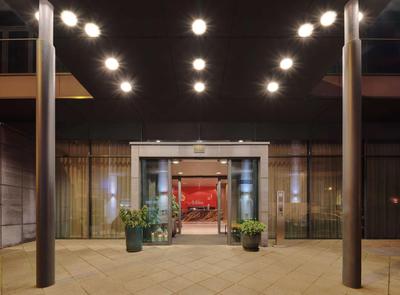
Altstadt
Adina Apartment Hotel Frankfurt Neue Oper
9.0· 2,314 reviews
approx. from£178 / nightSee prices
In this area
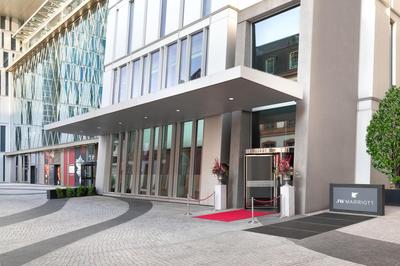
In this area
Getting around
The Altstadt is best on foot. The whole quarter is only a few hundred metres across, and the pleasure is in walking it — from the cathedral to the Römer, from the market to the river, from one reconstructed lane to the next. Much of the core is pedestrianised, which suits it. The neighbourhood is designed for moving slowly, stopping often, and noticing how the skyline keeps appearing between roofs.
The core U-Bahn stop is Dom/Römer on lines U4 and U5, directly under the historical centre. Tram lines 11, 12 and 14 stop at Römer/Paulskirche on the Braubachstraße route. From Frankfurt Hbf, it is two U-Bahn stops or about a 15–20 minute walk east, while the Hauptwache and the Zeil are only a couple of minutes north. Frankfurt Airport is roughly 15 minutes by S-Bahn, via S8 or S9, from the Hauptwache or Hauptbahnhof. For the museums and apple-wine taverns of Sachsenhausen, do not bother with transit at all: walk down to the Mainkai and cross the Eiserner Steg, a minute from the Römerberg, straight onto the Museumsufer. That is the city at its most legible.
Gallery
Altstadt in pictures
Altstadt — your questions
Is the Altstadt a good area to stay in Frankfurt?
Yes, especially for a first, sightseeing-led trip. You are beside the Römerberg, the cathedral, the Kleinmarkthalle and the river, with the Hauptbahnhof and airport train close by. The trade-off is that it is busy by day, quieter at night, and central hotels cost more.
Is Frankfurt’s Altstadt actually old, or is it a reconstruction?
Almost all of what you see is a reconstruction. The medieval old town was destroyed in the Allied air raid of 22 March 1944. The Römerberg’s Ostzeile was rebuilt from historical plans in 1986, and the Neue Altstadt between the cathedral and the Römer was completed in 2018.
What should I not miss in the Altstadt?
Do the loop: the Römerberg and Ostzeile, the 328-step climb up the Kaiserdom tower, the Krönungsweg through the Neue Altstadt, and a food stop at the Kleinmarkthalle — especially Schreiber, Gref-Völsing and the Wein-Balkon. Add the Paulskirche for its 1848 democracy history.
Is there nightlife in the Altstadt?
Not really. The quarter quiets down after dinner. For an evening out, head over the Eiserner Steg to Alt-Sachsenhausen for apple wine, or go toward the Bahnhofsviertel for bars and clubs.